

RAK Wireless
WisMesh High Power Booster WisBlock Starter Kit
WisMesh High Power Booster WisBlock Starter Kit
Notify me when back in stock
We'll only use your email for this notification.
Couldn't load pickup availability
The WisMesh High Power Booster Starter Kit from RAK Wireless is a high-power Meshtastic™ node kit built for one job: pushing your mesh farther. It pairs the nRF52840-based RAK3401 core with the RAK13302 high-power LoRa module, which adds a dedicated power amplifier and RF filter to the standard SX1262 radio.
Most mesh networks don't fail in the middle. They fail at the edges: the one hop that almost reaches the next town, the valley that drops packets, the node on the hill that hears everyone but can't get a reply back out. This kit is what you reach for when a standard node isn't quite enough.
Who it's for
- Router and repeater builders: filling coverage gaps on rooftops, towers, and hilltops where every dB counts.
- Rural and off-grid communities: connecting farms, cabins, and neighbors spread across miles of open country.
- Emergency response and preparedness groups: building backbone links that keep working when phones and internet fail.
Key Benefits
- 📡 More Transmit Power from the Skyworks SKY66122 amplifier, FCC certified for up to 290 mW in the US (versus about 160 mW on a typical node).
- 👂 Better Listening, Not Just Louder Talking thanks to a built-in RF filter that cuts out noise and keeps receive performance clean.
- ☀️ Solar and Battery Ready on the RAK19007 base board, with a JST battery port and a 5V solar input.
- ⚙️ Modular and Expandable with 4 WisBlock sensor slots for GPS, environmental sensors, and more.
How it Works
Pair your phone to the kit over Bluetooth using the free Meshtastic™ app, set your region, and it joins your mesh like any other node. The difference is under the hood: the SX1262 generates the LoRa signal, the SKY66122 amplifies it, and a SAW filter cleans it up on the way out and on the way in. The result is a stronger signal heading out and a quieter receiver listening for faint replies.
Most people deploy this kit as a fixed router or repeater. Drop it in a weatherproof enclosure with a solar panel and battery, connect a good external antenna, mount it high, and let it relay traffic for everyone around it.
✅ No Cell Towers
✅ No Internet
✅ No License
✅ No Subscriptions
✅ No SIM Cards
✅ Free, Open-Source Firmware & App
Choose Your Power Version
The RAK13302's amplifier pulls more current during transmit than the board's 3.3V regulator can supply, so it needs its own power feed. RAK makes two hardware versions depending on where that power comes from. They are not interchangeable after purchase, so pick the one that matches your deployment:
- Battery Powered: Runs on a standard 3.7V LiPo, the same kind of battery used in most Meshtastic™ radios. The RAK13302 boosts the voltage to 5v and the amplifier draws directly from the battery plugged into the base board's JST port, and USB or solar keeps it charged. Best for solar repeaters and portable nodes. (Battery required, sold separately.)
- 5V DC Powered: The amplifier takes a regulated 5V supply through its own connector on the underside of the RAK13302. Best for grid-powered installs like a rooftop node fed from a 5V adapter or a 12V-to-5V buck converter. (Power supply not included.)
Key Features
- RAK3401 WisBlock Core Nordic nRF52840 (ARM Cortex-M4F, 1MB flash, 348KB SRAM) with Bluetooth Low Energy. The same low-power MCU family used in the RAK4631, so battery life between transmissions stays efficient.
- RAK13302 High Power LoRa Module Semtech SX1262 transceiver plus the Skyworks SKY66122 front end. The hardware is capable of up to 1W (30 dBm); actual output is set in firmware to match your local regulations.
- Integrated RF Filtering Many DIY high-power builds boost transmit and hurt receive. The RAK13302's dedicated filter stage protects receiver sensitivity, so the links you gain actually work in both directions.
- FCC Certified Module The RAK13302 carries FCC ID 2AF6B-13302, certified for up to 290 mW (about 24.6 dBm) conducted output in the United States.
- RAK19007 Base Board USB-C for setup and power, a JST battery port, a 5V solar connector, and 4 sensor slots. It's the same base board used in the Beacon. This is a direct drop-in for the Atlavox Beacon.
- External Antenna Ready The LoRa radio uses an IPEX connector, and the kit includes an IPEX-to-SMA cable and rubber antenna. Swap in a fiberglass antenna on a mast for the biggest range gains.
- Dedicated Firmware Target This kit uses its own Meshtastic™ build (RAK3401 1W) so the amplifier is driven correctly. If you ever reflash, pick "RAK3401 1W" in the web flasher, not the RAK4631.
Specifications
| Frequency | 915 MHz band (US915) |
| RF Standard | LoRa (Meshtastic™ / MeshCore™) |
| Core Module | RAK3401, Nordic nRF52840, ARM Cortex-M4F, 1MB flash, 348KB SRAM |
| LoRa Module | RAK13302, Semtech SX1262 + Skyworks SKY66122 PA + SAW filter |
| Base Board | RAK19007 WisBlock Base Board, 4 sensor slots |
| Hardware TX Capability | Up to 1W (30 dBm) |
| US Certified TX Power | 290 mW (about 24.6 dBm) conducted, FCC ID 2AF6B-13302 |
| Peak TX Current | About 560 mA @ 5V at 24 dBm; about 1A @ 5V at 30 dBm (per RAK datasheet) |
| LoRa Connector | IPEX on RAK13302 |
| Wireless | Bluetooth Low Energy |
| Power Inputs | USB-C (5V), 5V solar (JST ZHR-2), LiPo battery (3.7v JST 2-pin); 5V DC version adds a dedicated 5V input on the RAK13302 |
| Operating Temperature | -40°C to 85°C (RAK13302 module) |
What's in the Box
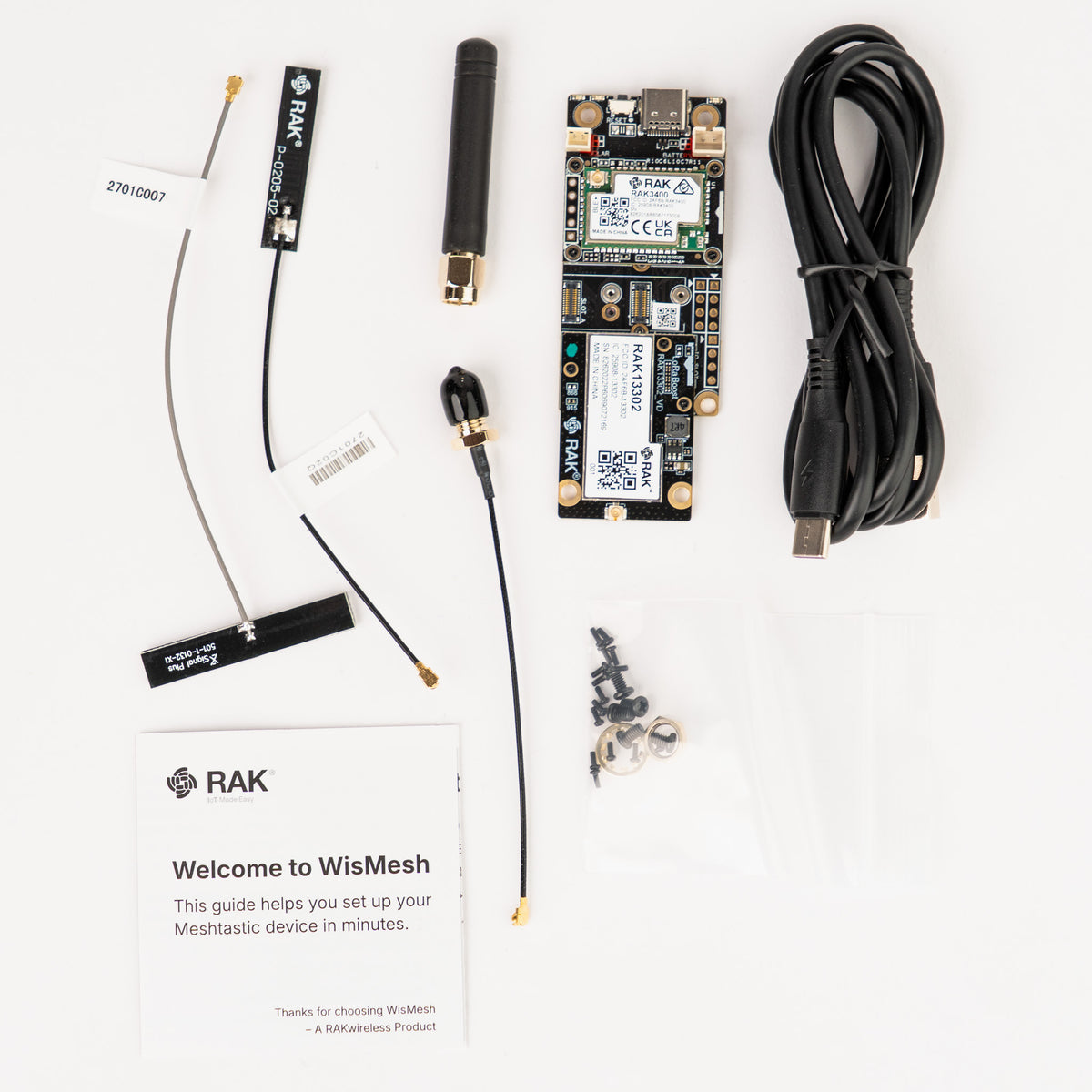
- 1 x RAK19007 WisBlock Base Board with 1 x RAK3401 WisBlock Core Module (nRF52840) and 1 x RAK13302 High Power LoRa Module (Battery Powered or 5V DC version) assembled.
- 1 x SMA rubber LoRa antenna
- 1 x IPEX-to-SMA cable for the LoRa antenna
- 1 x LoRa PCB antenna
- 1 x BLE PCB antenna
- 1 x USB cable
- 1 x 5V power cable (5V DC version only)
- 1 x set of screws
- 1 x quick start guide
Battery, solar panel, enclosure, and 5V power supply are sold separately.
Compatibility
- Fits the DIY Beacon Outdoor Radio Enclosure Kit for a weatherproof, solar-ready outdoor node
- Pairs with the 5W 6V Solar Panel with JST ZHR-2 Connector for self-sustaining operation
- Upgrade the antenna with the Waterproof IPEX to N-Type Antenna Cable and a 12" Fiberglass Antenna, N-Type, 3dBi
- Need a standard-power node instead? See the WisBlock Meshtastic Starter Kit
- Supports Meshtastic™ (RAK3401 1W firmware target) and MeshCore™ (flash yourself anytime)
FAQ
Should I get the Battery Powered or the 5V DC version?
If your node will run on solar and a LiPo, or you want to carry it, get the Battery Powered version. If it will sit somewhere with permanent power, like a rooftop or a shed with a 12V system and a buck converter, get the 5V DC version. The two use different RAK13302 hardware, so choose before you order.
Can I run it at the full 1 watt in the US?
No. The hardware can produce 1W, but the RAK13302's FCC certification covers up to 290 mW (about 24.6 dBm) of conducted output in the United States. That's still nearly double a standard 22 dBm node. Outside the US, power limits and frequency plans vary, and it's on you to set TX power, antenna gain, and frequency to match your local rules.
Can I just power it from USB?
Not on the Battery Powered version. USB alone can't supply the surge current the amplifier needs during transmit, so you need a 3.7v LiPo battery connected to the base board. USB and solar will keep that battery charged. The 5V DC version gets its amplifier power from a dedicated 5V input instead.
Will a higher-power radio really give me more range?
It helps, but it's not magic. Going from about 160 mW to 290 mW adds roughly 2.6 dB, which is a real but modest gain. Antenna height, antenna quality, and clear line of sight usually matter more. Where this kit shines is on a well-placed router node, where the extra power and the filtered receiver can turn an unreliable link into a solid one.
Does the antenna need to be connected before powering on?
Yes. Always connect the LoRa antenna to the RAK13302 before applying power. Transmitting into no antenna can damage the amplifier, and that matters more on a high-power radio than on a standard one.
Share